Before You Choose: An Honest Look at Online Memorial Websites
Looking at Legacy.com alternatives and other online memorial websites? Six honest questions about ownership, permanence, ads and family access.

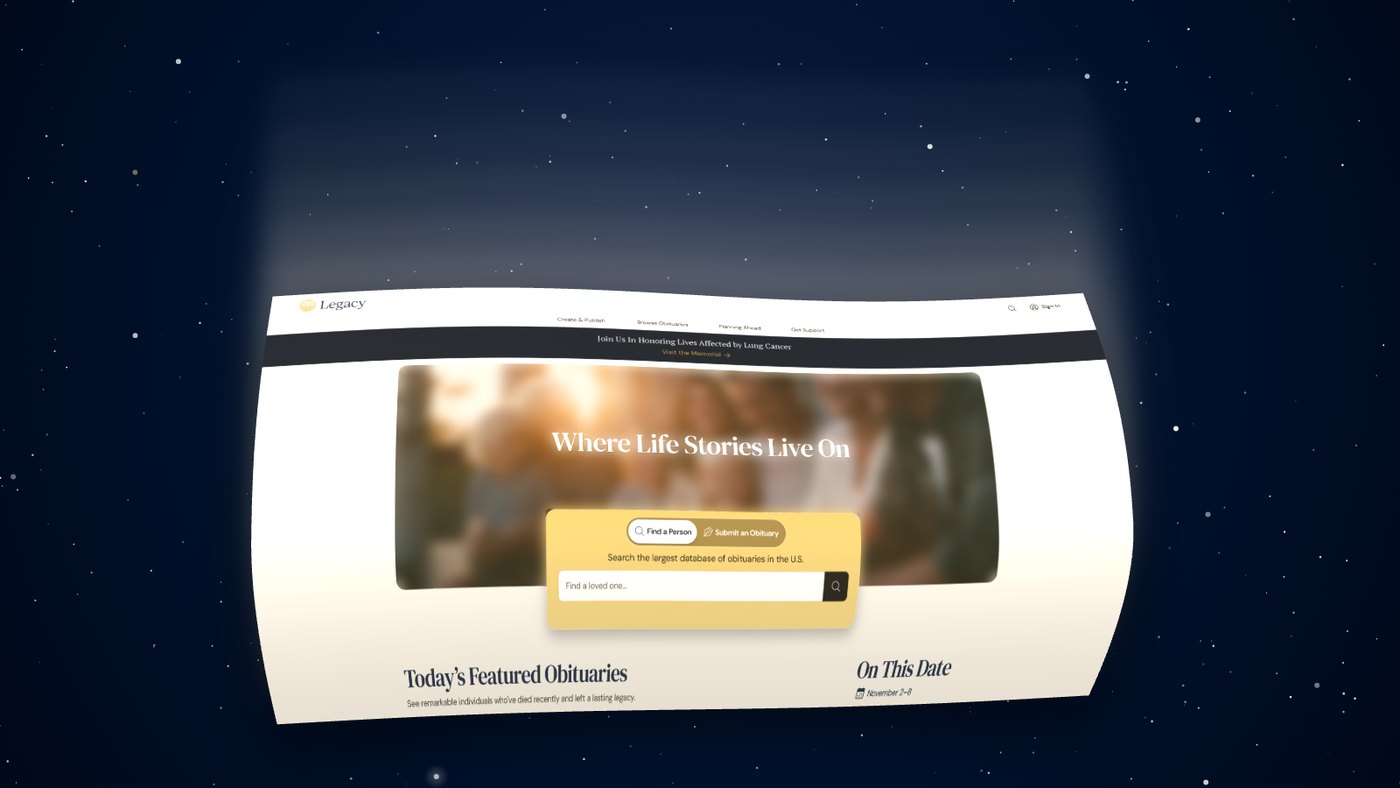
You are sitting at the kitchen table with your laptop and a mug of coffee that went cold an hour ago. You have eleven tabs open. Each one is an online memorial website, and each one has a soft photo of a sunset and a button that says “Create.” They all look kind. They all look the same.
And you are tired in a way that makes comparison shopping feel faintly absurd. You are not choosing a toaster. You are choosing where your father’s face is going to live.
So let us slow down for a minute. Not to make this more complicated, but to make it simpler: there are only a handful of questions that really matter, and you can ask them of any site.
Why people search for Legacy.com alternatives
Legacy.com is one of the best-known names in this space, largely because many newspapers publish their obituaries there, so it is often the first place people meet the idea of an online memorial. When people type “Legacy.com alternatives” into a search bar, it is usually not a complaint about any one site. It is a sign that they have started to think about what they actually want: a notice that a death happened, or a lasting place for a whole life, with photos, stories and voices.
Those are different jobs. A newspaper obituary is built to inform a community. A memorial page is built to hold a person. Some sites do one, some try to do both, and it helps to know which you are looking for before you compare anything.
Six questions to ask any online memorial website
These questions work for every site, including the one you are reading now. Read the pricing page, the terms, and the help pages. If an answer is hard to find, that is an answer too.
1. Who owns the page and the content? Can you, the family, edit, update or remove what you post? Is it clear that your photos and words remain yours? Look for plain language, not just a promise in a headline.
2. What happens in ten or twenty years? This is the big one, and the most awkward to ask. Is the page paid for once, or does it depend on a yearly renewal that someone has to remember? What happens if the card on file expires, or if the person who set it up dies too? A page that quietly disappears when a subscription lapses can be a second loss.
3. Can family and friends add their own memories? Some pages are a single voice. Others let a cousin in another country upload a photo, or an old friend write a story you never heard. If you want the page to grow, check how others contribute and whether you can review what is added.
4. Are there ads next to your person? Some sites are funded by advertising, which may mean banners or suggestions appearing near the memorial. Some families do not mind. Others find it jarring to see a sales pitch under their mother’s photo. It is worth looking at a real page on the site, not just the homepage, to see what visitors will see.
5. Can you get your content back out? If you ever wanted to move, could you download the photos, videos and texts you uploaded? Even if you never use it, knowing there is a way out is a kind of insurance.
6. What does “permanent” actually mean there? Many sites use the word. Read what stands behind it: a one-time payment, an ongoing plan, a policy about what happens to pages if the company changes. A careful site will explain this in ordinary words.
One reader, Grace, put it this way after she spent a weekend comparing: “I stopped looking at the designs. I started looking for the paragraph that says what happens to Mom’s page when I am not around to pay for it.”
The quiet problem of the digital afterlife
This is not just a family worry. In 2019 two researchers at the Oxford Internet Institute, Carl Öhman and David Watson, published a study in the journal Big Data & Society estimating how many profiles of people who have died will accumulate on one large social network over this century. Their projection was that, within a few decades, the profiles of the dead could outnumber those of the living. Their larger point was that nobody has really decided who looks after all these traces of human lives, or for how long.
No family can solve that for everyone. But it is a useful thing to keep in mind for your own family: whatever you choose, it helps to know who will be responsible for it when you are old, and when your children are old.
Online memorial websites: other things worth checking
A few smaller things that can make a real difference once the big questions are answered:
- Privacy settings. Can the page be public, or shared only with people who have the link?
- Languages. If your family is spread across countries, can relatives read and write in their own language?
- Video and voice. Can you upload a voice recording or a short video, not just photos?
- Moderation. If a stranger leaves something unkind, can you remove it?
- How it looks on a phone. Most relatives will visit from their phone, often late at night. Open a sample page on yours.
- A real example. A demo page tells you more than any feature list.
If you would like a walk-through of setting one up, there is a guide on how to create an online memorial page.
Where we stand
It would be strange to write all this and not say what we built. Stella Memoria is a memorial page meant to stay, with a one-time payment on the Forever plan. Family can add the story, photos, videos and voice recordings; relatives and friends can add their own memories from wherever they live; visitors can leave candles, flowers and prayers. You can look at a finished example on the Ann Miller page and ask it the same six questions as every other site. That is exactly what we would hope you do.
Whatever you choose, choose it slowly, with the cold coffee and the eleven tabs, and with the knowledge that there is no wrong answer that cannot be fixed. The page is not the person. But it can be a good, steady place to visit them.
Frequently asked questions
What is the difference between an obituary site and a memorial website?
An obituary site mainly publishes death notices, often in partnership with newspapers, with service details and a short life summary. A memorial website is usually a fuller, ongoing page for one person, with a life story, photo galleries, videos and memories added by family and friends over time.
Are online memorial websites permanent?
It depends on the site. Some pages are paid for once, while others rely on a subscription or on advertising. It is worth reading exactly what the site says will happen to the page over the long term and if payments stop.
Can I move a memorial page from one site to another?
Usually you can recreate it, but it is easier if you kept copies of the photos, videos and texts you uploaded. Before choosing a site, some families check whether it offers a way to download their content.
Is it better to choose a site with or without ads?
That is a personal choice. Ad-supported sites may cost less upfront, while sites without ads usually charge for the page. Looking at a real memorial page on each site shows you what visitors will actually see.
To send it to someone, or to post it.